The living API catalog
Completed repository scans refresh the API collections derived from that repository. The catalog gives you a searchable view of those APIs, their quality findings, and available source context.
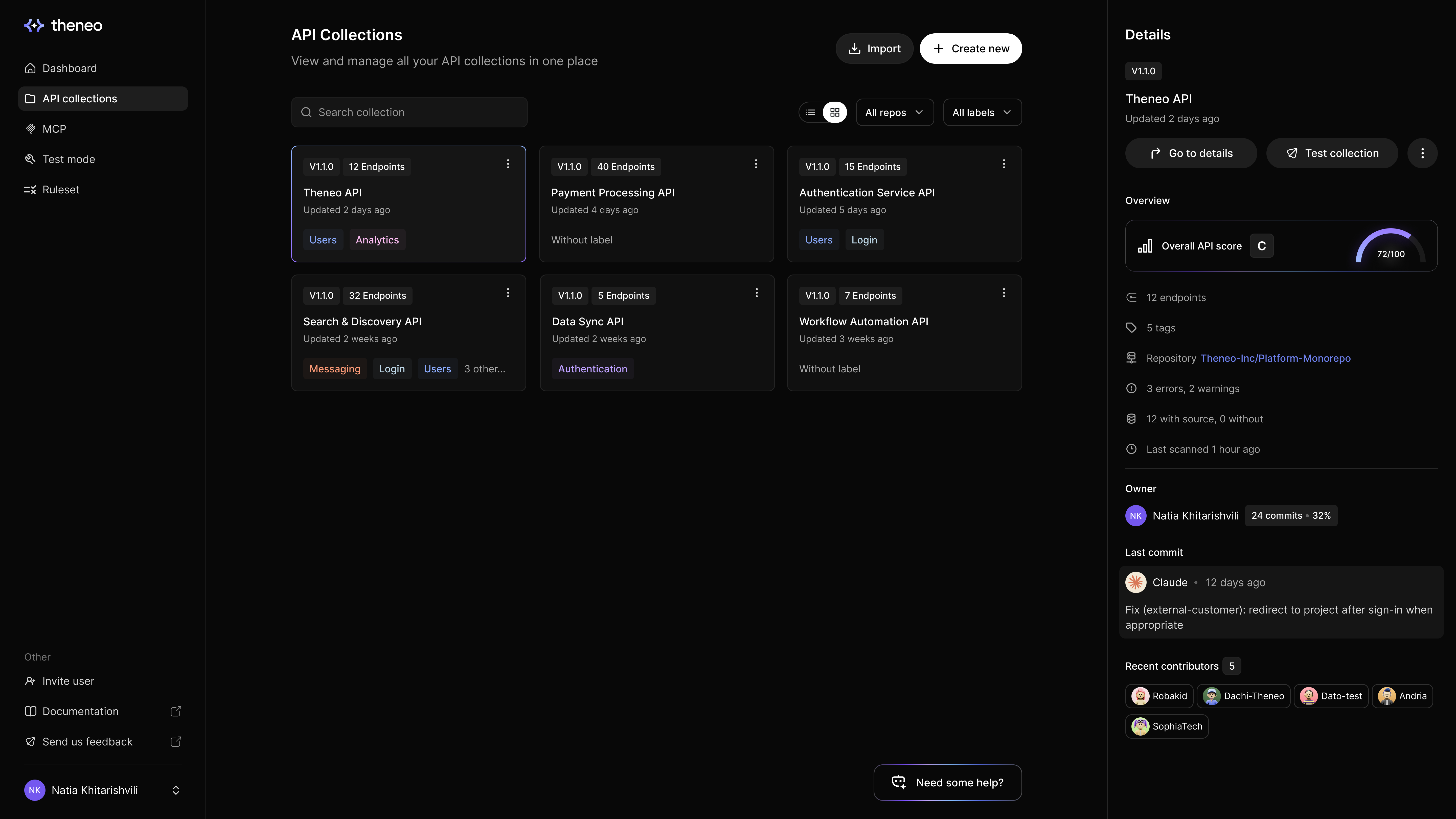
What a collection is
A collection contains an API specification and the information Elva derives from it:
Information | Use |
Stored specification | Inspect discovered or imported endpoints, parameters, and schemas. |
Quality report | Review grades, coverage, errors, and warnings. |
Searchable API content | Find operations, schemas, and parameters through catalog search and the assistant. |
That means a collection is never a static file dump. It is a scored, indexed, agent-queryable unit of your API surface.
How the catalog organizes itself
When Elva scans a repo, it does not drop one giant spec on you. It derives buckets and materializes each one as a collection, so your catalog mirrors how your system is actually built.
Repo shape | What Elva does |
No services detected | Collapses to a single All endpoints collection (only if endpoints exist) |
Normal service | One collection per service |
Large service | Splits into per-domain collections when it has 50+ endpoints across 3+ domains, keeping a Misc bucket so nothing is lost |
Same domain in several services | Merges into one repo-wide collection (for example, Users across core and frontend) |
Understand refresh and reconciliation
A rescan reflects the selected repository branch. It may reorganize or remove collections derived from routes that are no longer found, so review scan results and downstream contracts or MCP servers. Updating the catalog does not publish updated tool definitions; review, sync or rebuild, and publish separately.


On this page
- The living API catalog