How Elva works
Elva connects API discovery, collections, contracts, quality scoring, testing, and hosted MCP servers. Start with a repository or specification, review the discovered API, and publish the surface you want consumers to use.
Collections describe your APIs; contracts define consumer-facing subsets; MCP deployments expose published operations as agent tools.
The pipeline, end to end
Ingest an API into a collection, review its endpoints and quality findings, choose a contract or MCP surface, and publish it. Testing and insights help you verify what consumers can actually call.
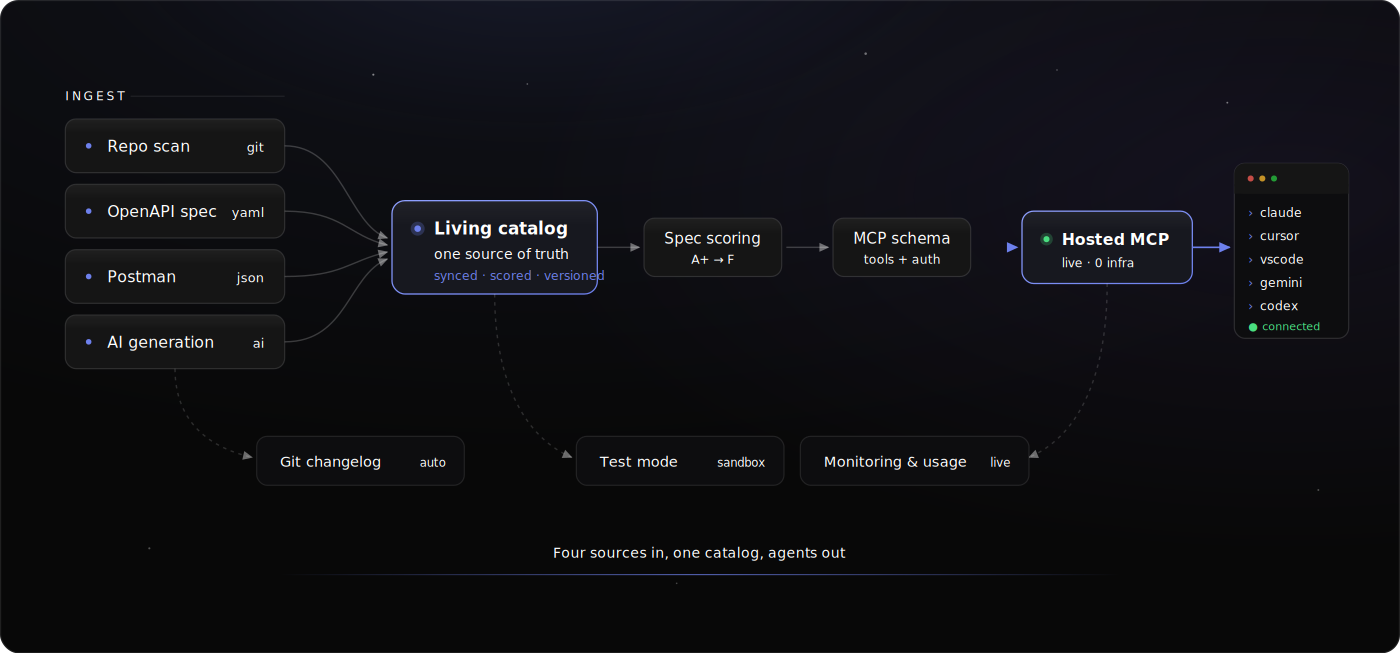
Built for the agentic era
APIs were documented for humans reading docs pages. Agents need something stronger: interfaces they can discover, trust, and call, backed by specs that are actually current. In most companies the spec drifts from the code within weeks, the catalog is a wiki nobody updates, and every team hand-rolls its own MCP plumbing. Elva replaces all of that with one pipeline that starts from whatever you already have, a repo, a spec, a Postman workspace, or a plain-language prompt, and ends with a governed, monitored, agent-callable API surface.
The pipeline, stage by stage
Each stage in the diagram above earns its place. Together they turn a moving codebase into an API surface agents can rely on:
Ingest | Connect and scan a repository, import an OpenAPI document, or import from Postman. |
Review | Inspect the collection, source information, descriptions, schemas, and quality findings. |
Define exposure | Choose endpoints, fields, upstream target, and authentication. |
Publish | Release the reviewed contract artifacts or MCP deployment. |
Verify | Test realistic calls and inspect activity. |
Maintain | Rescan or reimport, review drift, sync intended changes, and publish again. |
Keep source and published tools current
A completed scan updates the source-backed collection. It does not automatically publish an updated contract or rebuild every MCP server. Review drift, synchronize the intended changes, obtain any required approval, and publish. Verify that connected clients see the expected tool list.
Start where your APIs are
Elva is built by the team behind Theneo, trusted for API documentation from top startups to Fortune 500 companies. If you want to see the pipeline on your own code, the quickstart takes you from a cold repo to an agent making real calls in six moves, and it all starts at app.getelva.ai.


On this page
- How Elva works